
 Product Search


The Ultimate Guide to Induction-Hardened Chrome Rods
 May 08, 2026|
 View:431
You find the ultimate guide to induction-hardened chrome rods when you need strong rods for hard jobs. These rods use special induction hardening, chrome plating, and QPQ treatments. You get great wear resistance, better fatigue strength, more buckling resistance, corrosion protection, and careful manufacturing. The ultimate guide to induction-hardened chrome rods explains how quality, toughness, and flexibility help industries that need dependable parts. The ultimate guide to induction-hardened chrome rods helps you see why toughness is important when picking rods for important uses.
Key Takeaways
Induction-hardened chrome rods are much stronger than regular chrome rods. They last longer and work well for tough jobs. The induction hardening process makes the outside very hard. The inside stays flexible. This helps the rod resist wearing out and breaking. Chrome plating keeps the rods safe from rust and damage. This makes them last longer in rough places. Picking the right material and size for your chrome rod is very important. You should think about how much weight it will hold and how often it will move. You can also get custom chrome rods. This means you can choose the size, how exact it is, and how smooth the surface is. This helps your rod fit your project perfectly.
The Ultimate Guide to Induction-Hardened Chrome Rods Overview
What Are Induction-Hardened Chrome Rods
Induction-hardened chrome rods are used for tough jobs. They work well when parts must handle heavy loads. These rods go through induction hardening. This process heats the rod’s surface fast. Then, it cools the rod quickly. The outside becomes very hard. The inside stays strong. The rod does not bend or break easily. It also does not wear out fast.
Induction-hardened chrome rods are different from standard chrome rods. You can see the main differences in the table below:
Type of Rod | Hardness (HRC) | Wear Resistance | Suitable Applications |
|---|---|---|---|
Induction-Hardened Chrome | 50-62 | High | Heavy-duty, high-impact, abrasive |
Standard Chrome | 15-22 | Moderate | Moderate-duty applications |
Induction-hardened chrome rods have a hard layer under the surface. Standard chrome rods only have a hard layer on the outside. Induction-hardened rods are stronger. They last longer when used for hard work.
Making induction-hardened chrome plated bars has steps:
Induction hardening makes a deep, strong layer.
A hard chrome layer is added and made smooth.
This design helps the rod support heavy loads. It also makes the surface hard and protects against rust.
Key Features and Materials
You want rods that last a long time. Induction-hardened chrome rods use strong steel like C45, C35, and stainless steel. These materials make the rods hard and strong. Top companies, like Hengzhixin, use these steels. Their rods work in many industries.
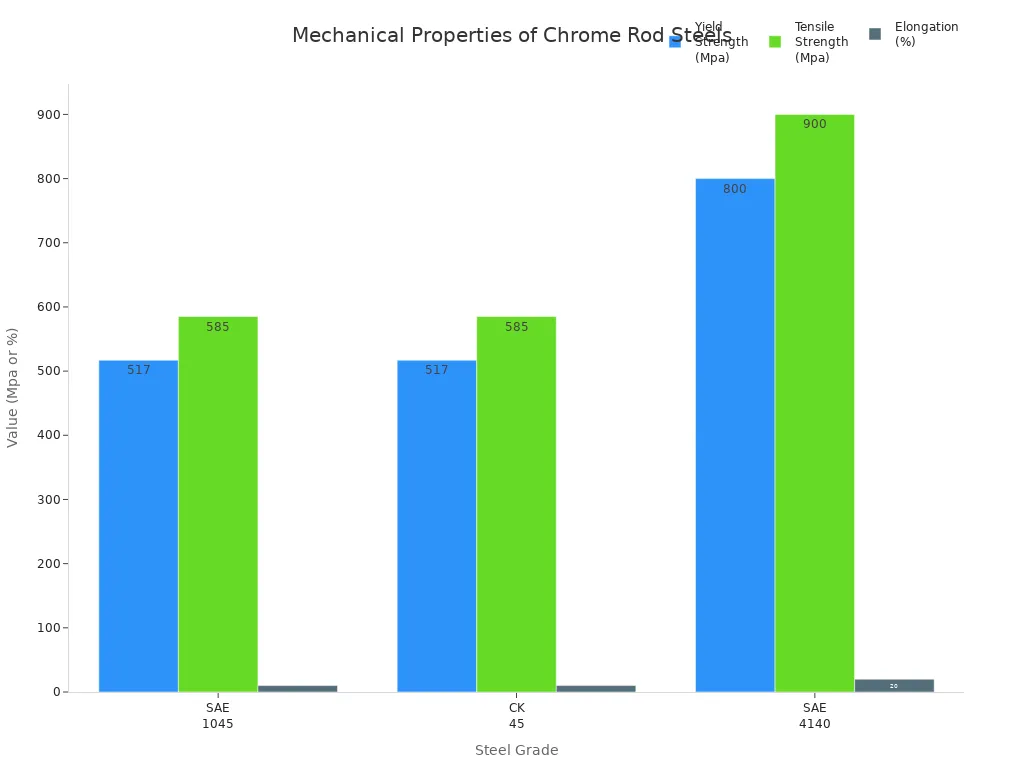
Here is a table showing common steel grades and their properties:
Steel Grade | Chemical Composition % | Yield Strength | Tensile Strength | Elongation | Hardness |
|---|---|---|---|---|---|
SAE 1045 | 0.43-0.50 (C), 0.60-0.90 (Mn), 0.040 Max (P), 0.050 Max (S) | 75000 psi / 517 Mpa | 85000 psi / 585Mpa | 10% | Rc 60-72 |
CK 45 | 0.42-0.50 (C), 0.50-0.80 (Mn), 0.035 Max (P), 0.035 Max (S) | 75000 psi / 517 Mpa | 85000 psi / 585Mpa | 10% | Rc 60-72 |
SAE 4140 | 0.36-0.44 (C), 0.1-0.4 (Si), 0.65-1.1 (Mn), 0.04 (P), 0.04 (S), 0.75-1.2 (Cr), 0.15-0.35 (Mo) | Min 800 Mpa / 115K psi | Min 900 Mpa / 130K psi | 20% | 270 HB |
These rods also get special surface treatments. Chrome plating helps stop rust and makes the rod smooth. QPQ treatment makes the rod harder and helps it last longer. It also makes the rod stronger and helps it not wear out. These treatments help the rods work well in tough places.
Tip: If you pick induction-hardened chrome rods, you get strong steel. You also get high hardness and special coatings. This gives you great performance.
Induction Hardening Process
How Induction Hardening Works
Induction hardening is a smart way to make chrome rods stronger. This process uses heat and electricity to change the rod’s surface. You put the rod inside a coil. The coil sends electricity through the rod. The rod gets hot very quickly. Then, you cool the rod fast with water or oil. The outside of the rod becomes very hard. The inside stays strong and flexible.
Here is a table showing the main steps in induction hardening for chrome rods:
Step | Description |
|---|---|
1 | Induction case hardening starts by changing the surface of chrome rods. |
2 | The process makes the rod better at handling impacts. |
3 | Customer needs for hardness and depth are saved in the system. |
4 | Steady feed rates and careful cooling help make the rods uniform. |
5 | You get rods that are easy to machine every time. |
You can control how deep and hard the rod gets by changing the induction frequency and power. This lets you make rods with different strengths for different jobs. Induction hardening helps rods last longer and work well in tough places.
Note: Induction hardening makes the surface harder and helps stop wear. The inside stays tough. The rods do not bend or break easily.
Benefits for Strength and Durability
Induction hardening gives many good benefits. You get rods that are strong and last a long time. The process creates compressive stresses in the hard layer. These stresses help the rod resist cracks and fatigue. Fatigue life gets much better. Induction hardening increases high-cycle fatigue strength by more than 45% compared to rods that are not treated.
Induction hardening makes the surface harder and stops wear.
The core stays tough and flexible.
Compressive stresses help the rod last longer.
The rods can handle shocks and tension without cracking.
Induction hardening lets you use chrome rods for hard jobs. You can trust these rods to last longer and work better. You see the difference when strength and durability are important.
Chrome Plating Process Explained
Steps in Chrome Plating
It is important to know how chrome plating works. This process uses many steps to make rods strong and shiny. Each step helps the rod last longer and look nice.
Here is a table showing the main steps in chrome plating for rods:
Step Number | Step Name | Description |
|---|---|---|
1 | Surface Preparation | The part gets cleaned to remove dirt. This helps the chromium stick better. |
2 | Activation Bath | The rod goes into a weak acid bath. This gets the surface ready for chromium to bond well. |
3 | Base Layer Application | A nickel layer is added by electroplating. This makes the rod smoother and stops rust. |
4 | Chromium Plating | The rod sits in a chromium bath with electricity. Chromium sticks to the rod’s surface. |
5 | Rinsing and Drying | The rod is rinsed to wash away chemicals. Then it is dried and polished for a shiny finish. |
6 | Inspection and Quality Control | The rod is checked for defects. This happens before using or processing the rod further. |
Chrome plating does more than make rods shiny. It makes them stronger and protects them from damage. Quality control is very important. Workers check the thickness of the plating often. They change the process if needed. Machines help track things like current, temperature, and pH. This careful checking makes sure every rod is high quality.
Surface Quality and Corrosion Resistance
Chrome plating gives rods a smooth and bright surface. The thin chromium layer makes the rod harder and stops wear. The rod looks good and lasts longer.
Makes rods harder and tougher
Adds a layer that protects from rust
Helps stop wear and tear
Gives a shiny and nice look
Hard chrome plating protects the rod from water, chemicals, and pollution. This keeps the rod strong for a long time.
You can trust rods with hard chrome plating in tough places. Salt spray tests show rods with nickel and chrome layers resist rust very well. This is good for places with water or chemicals. Chrome plating gives you both strength and beauty.
Unmatched Wear Resistance and Other Advantages
Wear and Fatigue Strength
You need rods that can do hard work every day. Induction-hardened chrome rods are great at stopping wear. These rods are good for places where parts move a lot. The special hardening process changes the inside of the rod. This makes the outside very hard and strong.
You can look at the table to see how these rods are different from others:
Rod Type | Hardness (RC) | Wear Resistance |
|---|---|---|
Induction-Hardened Chrome | 55-60 | Superior due to microstructure changes |
Chrome-Plated Rods | 45-50 | Adequate for less demanding applications |
Induction-hardened chrome rods last longer and are stronger. They do not wear out fast. These rods are made for tough jobs. You can use them in machines that run all day.
Induction-hardened chrome rods have a strong core, so they handle more stress.
You can count on these rods for hard work.
Chrome-plated rods are better for easy jobs.
Induction-hardened chrome rods work better and last longer. They do not crack or break from being used over and over. This means your machines will last longer and work well.
Corrosion Protection
You want rods that stay strong in wet or dirty places. Chrome plating keeps the rod safe from water and dirt. It also protects against chemicals. QPQ treatment helps too, but chrome plating lasts longer in tough places.
Here is a table that shows how chrome plating and QPQ work:
Treatment | Corrosion Resistance |
|---|---|
Chrome Plating | Exceptional resistance in harsh conditions; 200-250 hours in NSS without corrosion (ISO-9227/ISO-10289 standards). |
QPQ Nitrocarburizing | Good corrosion protection, but variable results; resistance ranges from 100-150 hours in NSS. |
You can use both treatments together for even better results. Chrome plating gives the best protection. QPQ makes the rod harder and helps stop wear. Salt spray tests show chrome plating lasts over 200 hours with no rust. This means the rods work well in hard places.
Tip: Pick rods with both chrome plating and QPQ for the best protection and wear resistance.
Surface Precision
You want rods that move smoothly and seal well. A smooth surface helps the rod slide and keeps oil or air inside. Induction-hardened chrome rods have a very smooth finish.
The table below shows what different surface roughness values mean:
Surface Roughness (μm Ra) | Performance Impact |
|---|---|
0.1–0.3 | Balances sealing performance, lubrication, and wear resistance |
0.2–0.3 | Commonly controlled for optimal performance in hydraulic applications |
These rods can have a surface roughness as low as Ra 0.2 μm. This is good for hydraulic systems and gas springs. The smooth surface helps the rod last longer and work better. You get fewer leaks and less friction. Your machines run quietly and last a long time.
Note: Always check the surface finish when picking rods. A smooth rod works better and lasts longer.
You can trust induction-hardened chrome rods for tough jobs. They give you great wear resistance, strong protection from rust, and smooth movement. These rods help your machines work well and last longer.
Applications of Induction-Hardened Chrome Rods
bike front shocker rod
You want the best bike ront shockerred for mountan and e- bikes. Qualty maters most when you choose a bike front shocker rod The right materal and surfacetreatment give your bike front shocker rod power and long life. The QPQ Bicycle Front Fork Damping Rod stands out for high performance. Mountain and e-bikeriders need a bike front shocker rod that fits theiriding style and fork type. You should aways check your bike front shocker rod for the best match
Automotive and Industrial Uses
Induction-hardened chrome rods are important in cars and factories. These rods must be hard and resist wear. They also need to resist rust and be the right size. Long life is important for these rods. Hard chrome plated steel bars are used in machines that need to be precise and resist rust. Car parts need to hold heavy loads and be measured exactly. Strong piston rods help vehicles run smoothly. Factories use these rods for important jobs. You can trust them to work well in tough places.
Industry | Specific Applications |
|---|---|
Role in Seat Adjustment Mechanisms | You slide itforward or backward to find the best position. Hard chrome plated rods help make this movement smooth and easy.These rods sit inside the seat sliders and adusment handles. |
Manufacturing | Used for precision in important jobs |
Automotive | Needed for parts that must be strong |
Furniture and Medical Equipment
Induction-hardened chrome rods are found in furniture and medical tools. These rods have a hard surface and smooth finish. Hard chrome plated steel bars help moving parts last longer. The chrome layer protects them from rust. Strong rods keep furniture and medical beds safe and sturdy. The smooth surface lowers friction and helps things work better. Heavy-duty piston rods help beds and chairs move easily.
Property | Description |
|---|---|
Hard surface and smooth finish make parts last longer. | |
Superior Corrosion Protection | Thick chrome layer keeps rods safe from rust and damage. |
High Strength and Durability | Strong core resists heavy loads and keeps things safe. |
Increased Operational Efficiency | Smooth surface lowers friction and saves energy. |
Hard chrome plating is used in many places. Induction-hardened chrome rods help your equipment last longer and work better.
Selecting the Right Induction-Hardened Chrome Rod
Material and Diameter Choices
You have to pick the right material and size for your induction hardened chrome rod. The material you choose decides how strong and tough the rod will be. You can pick C45, C35, or stainless steel. Each one is good for different jobs. The rod’s diameter and length are important too. Bigger rods can hold more weight. Smaller rods fit in small spaces.
Material composition
Diameter
Length
Hardness level
Surface finish
Application requirements
The hardness level is very important. Induction hardening can make the surface as hard as 60 HRC. This makes the rod better at fighting wear. This is needed for jobs with heavy loads and lots of movement.
You should pick the rod’s size and material for your project. Think about how much weight the rod will hold and how often it will move.
Plating Thickness and Surface Finish
You want your induction hardened chrome rod to last and work well. Plating thickness keeps the rod safe from rust and damage. A thicker chrome layer gives more protection. Surface finish matters too. A smooth rod slides better and helps your machine run well.
A smooth finish helps lower friction.
It can make your machine work better.
The right surface finish can make hydraulic machines 25% more efficient.
A rough surface can cause more wear and less efficiency.
The job you need the rod for decides how smooth it should be.
Check the surface finish before you buy a rod. A smooth rod lasts longer and works better.
Customization Options
Sometimes you need special rods for your project. Companies can make rods just for you. You can pick the size, how exact the rod is, and extra steps before it is finished.
Customization Aspect | Description |
|---|---|
Size | Many sizes to fit what you need |
Tolerance | Made carefully to match your measurements |
Pre-processing | Steps like grinding to make the rod smoother and better |
You can ask for induction hardened chrome rods with special sizes or finishes. Custom rods help your machines work their best. Always tell your supplier what you need.
You get strong and steady results with induction-hardened chrome rods. Good factories use special ways to make these rods tough. They check the rods carefully so they do not bend or break. These rods are used in bikes, car parts, and medical tools. When you pick a rod, talk to trusted companies. The table below tells you what to look for:
Feature | What to Look For | Why It Matters |
|---|---|---|
Testing Protocols | 100% pressure testing | Ensures zero leaks upon installation |
Lead Times | Consistent, realistic windows | Prevents project delays |
Certifications | ISO 9001 or industry-specific | Proof of quality management |
After-Sales Support | Maintenance kits and advice | Extends equipment lifecycle |
Ask for prices or help to pick the best induction hardened chrome rod for your job.
FAQ
What makes induction-hardened chrome rods different from standard rods?
These rods have a hard outside and a strong inside. Induction hardening makes them stronger. Chrome plating helps stop rust. Standard rods do not have these extra features.
How do you choose the right material for your application?
Think about what your job needs. C45 and C35 steel are good for heavy work. Stainless steel does not rust easily. Pick the material that fits your job and place.
Can you customize the diameter and length of chrome rods?
You can ask for special sizes. Makers offer rods from Ø6–30mm and up to 1000mm long. You pick the size that works for your project.
How does QPQ treatment improve rod performance?
QPQ treatment makes the surface harder and lowers friction. This helps the rod last longer and resist wear. It also protects the rod from rust.
Where do you use induction-hardened chrome rods?
These rods are used in gas springs, cars, furniture, and medical tools. They work well where strength and toughness are needed.


