
 Product Search


Wholesale Solid Gas Spring Piston Rods Strictly Within 6mm To 30mm Size
 Sep 09, 2026|
 View:148
When you need dependable parts for your gas spring assemblies, HZX sells wholesale solid gas spring piston rods. These rods come in sizes from 6mm to 30mm in diameter. You can pick from SAE 1045 carbon steel or 304 stainless steel, each has different benefits for your needs. The standard h8 tolerance and 0.2μm Ra surface finish help the seals work well and last long.
These exact sizes work well in many different uses, like cars, furniture, and factory machines. Knowing how rod size affects force helps you pick the right one for your gas springs. This guide explains how to choose size, what specs matter, and where to buy, helping you make wise choices for durable, high-performance components.
Key Takeaways
Pick the rod size by how much force you need: bigger rods lower the pull-back force, but they don’t change the push-out force.
Choose SAE 1045 carbon steel to save money, or pick 304 stainless steel if you need protection from rust.
Make sure the rods have h8 tolerance and a 0.2μm Ra surface finish so the seals work well and last a long time.
Choose the rod size based on what you need it for. Use 6mm for light jobs, 8mm for medium jobs, 10mm for heavy jobs, and up to 30mm for factory or industrial work.
Order custom lengths and finishes to match your exact assembly needs, with minimum orders starting at just 100 pieces.
Gas Spring Piston Rods: Size Range and Selection
Available Diameters and Length Options
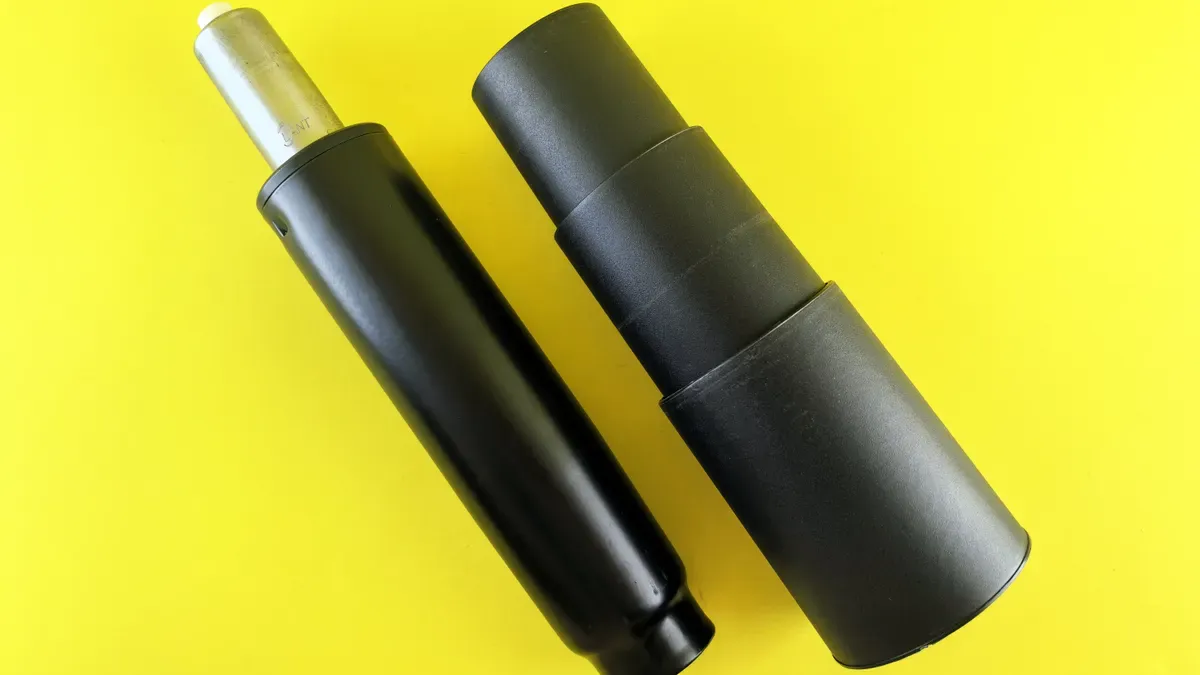
HZX makes solid gas spring piston rods with widths from 6mm to 30mm. This range covers every common gas spring type you might need. Mini gas springs use 4mm rods, compact units use 6mm, standard models use 8mm, and heavy-duty versions use 10mm or bigger. The 6mm to 30mm span includes all these types and goes well past them.
Standard length choices usually run from 100mm to 600mm. You can order rods at any length within this range. HZX also makes custom lengths for each order, so you can ask for exact sizes that fit your assembly needs. Common longer lengths on the market include 7.5 inches, 8.4 inches, 9.13 inches, 9.69 inches, 10 inches, and 10.55 inches.
The width you choose pairs with a specific tube size. Standard pairs include 6/15 mm (rod 6mm, tube 15mm), 8/18 mm, 10/22 mm, 12/25 mm, and 14/28 mm. These pairs ensure proper fit and seal performance. The tube must hold the rod while leaving space for the gas charge and sealing system.
Gas Spring Category | Rod Diameter (mm) |
|---|---|
Compact Gas Springs | 6 |
Standard Gas Springs | 8 |
Heavy Duty Gas Springs | 10 |
Choosing the Right Rod Diameter for Your Gas Spring
Rod width directly affects force output, but not in the way you might think. According to Pascal's law, force equals pressure times effective area. The table below shows how this works:
Stroke | Effective area | Force formula | Rod-diameter effect |
|---|---|---|---|
Extend | π·d_bore²/4 | F_extend = P × (π·d_bore²/4) | None; rod is not in the pressurized area |
Retract | π·(d_bore² − d_rod²)/4 | F_retract = P × [π·(d_bore² − d_rod²)/4] | Larger d_rod reduces the effective retract area, so retract force decreases |
The extend stroke pushes the rod outward. During this motion, the rod does not take up space in the pressurized chamber area. So, rod width does not change extend force. The retract stroke pulls the rod inward. Here, the rod fills space inside the bore, lowering the effective area. A bigger rod width means less area for pressure to push on, so retract force goes down.
This idea matters when you pick a rod for your gas spring. If your use needs strong extension force with controlled retraction, a bigger rod helps. If you need balanced forces in both directions, choose a smaller rod compared to the tube.
The stroke of a gas spring also depends on rod length and tube size. Longer rods allow longer strokes, but the tube must be long enough to hold the rod when fully compressed. The closed length of your assembly equals the compressed tube length plus rod-end fittings. You must think about this when choosing rod length.
Damping features vary with rod width too. Gas springs provide damping through internal orifices that control fluid flow. The rod width affects internal pressure changes during compression and extension. Proper damping ensures smooth, controlled motion without sudden jerks or slams.
For car uses, standard rod/tube pairs like 6/15 mm, 8/18 mm, and 10/22 mm serve hood props, trunk lifts, and hatch supports. Factory machines often use the same pairs. Furniture and medical tools typically use smaller rods in the 6mm to 10mm range. Heavy-duty uses may need rods up to 30mm.
Think about your force needs carefully. Gas springs create forces from about 10N to 2400N depending on setup. The rod width you pick must match the tube size and pressure rating to reach your target force. HZX can help you through this selection process.
Key Specifications for Gas Springs and Piston Rods
Material Grades and Hardness Requirements
Your choice of material determines how well your gas spring piston rods handle everyday demands. HZX offers two primary grades. SAE 1045 carbon steel suits standard applications where cost matters. This medium-carbon steel provides good strength for typical automotive and furniture uses. For corrosive environments, 304 stainless steel offers superior resistance to rust and chemical attack. You would select this grade for marine equipment, medical devices, or outdoor installations where moisture persists.
Hardness directly affects wear resistance and service life. Carbon steel rods typically receive a hardness treatment reaching HRC 20-30. This range balances machinability with surface durability. For enhanced protection, manufacturers apply hard chrome plating. This treatment achieves microhardness values above 900 HV0.1. Such hardness levels resist scratching and maintain a smooth surface even under repeated sliding contact.
Surface treatments extend rod life considerably. Chrome plating remains the conventional choice for carbon steel rods. It improves both wear and corrosion resistance. Salt-bath nitriding offers another option for carbon steel. This process hardens the surface layer without affecting the core properties. Nitrotec surface treatment provides yet another path. It delivers wear resistance, low friction, and corrosion resistance comparable to stainless steel. This method also avoids toxic by-products, making it environmentally friendly.
Tolerance, Surface Finish, and Corrosion Resistance
Precision matters for seal longevity. HZX manufactures rods to an h8 tolerance standard. This specification ensures consistent diameter across each rod. A uniform diameter allows seals to maintain constant contact pressure. Any variation would create uneven wear or leakage paths.
Surface finish plays an equally critical role. HZX achieves a standard finish of 0.2μm Ra. This fine smoothness creates microscopic pockets that hold thin oil films. These films reduce friction during operation. The smooth metal also prevents seal scraping and abrasion. Even coatings resist corrosion better on smooth surfaces. All these factors contribute to extended rubber seal life.
Different seal materials require different surface finishes. The table below shows recommended values:
Seal Material | Recommended Ra (μm) |
|---|---|
PTFE / Filled PTFE | 0.1–0.3 |
Polyurethane (PU) | 0.3–0.6 |
NBR / HNBR | 0.3–0.5 |
FKM / FFKM | 0.2–0.4 |
For gas springs using PTFE seals, you would aim for the smoother end of the range. The 0.2μm Ra finish from HZX fits well within these recommendations.
Corrosion resistance involves more than material choice. The surface treatment you select must match your operating environment. Chrome plating provides a hard, corrosion-resistant barrier. Nitreg nitriding achieves high surface hardness while improving wear resistance. This treatment also minimizes friction and extends service life. Tests confirm consistent white layer thickness and oxide thickness after treatment. ONC post-nitriding oxidation adds another layer of corrosion protection. It also improves the aesthetic appearance of the rod.
Quality assurance underpins every specification. HZX operates under ISO9001 certification. Independent SGS test reports verify product consistency. These certifications ensure you receive rods that meet stated tolerances and finishes batch after batch.
The combination of correct material, hardness, and surface finish directly impacts gas spring performance. A properly specified rod reduces friction, extends seal life, and maintains consistent damping characteristics. When you order wholesale, you need this reliability across thousands of pieces. The closed length of your assembly depends on precise rod dimensions. Any deviation affects fit and function.
Proper surface treatment also supports damping control. Smooth rod surfaces allow consistent seal interaction. This consistency translates to predictable damping forces throughout the stroke. You avoid the jerky motion that comes from uneven friction. For gas springs in critical applications like medical beds or car tailgates, this predictability matters greatly.
Gas Spring Application Across Industries
Automotive and Industrial Machinery Uses
Gas springs work hard in vehicles and factories every day. Car hoods and tailgates use them for smooth lifting help. They hold panels open during maintenance or loading, giving you easy access to engine areas and cargo spaces. The 6mm to 30mm rod range covers all automotive needs, from small hatch supports to heavy utility panels.
Industrial machinery offers even more chances for gas spring use. Access panels, machine covers, and operator arms all benefit from controlled motion. In car plants, tool lifts and inspection hoods use these parts all the time. Food and packaging machines rely on them for feeder systems and protective door lifts. You will also see them in vacuum packing machines, ATM units, and generator covers.
The rod size you pick directly sets the force capacity. This table shows the link:
Rod diameter (mm) | Force range (N) | Typical application |
|---|---|---|
6 | 50–400 | Small cabinet doors, tool storage lids |
8 | 100–650 | Campervans, furniture lids, garden storage |
10 | 150–1200 | Car bonnets, industrial access panels |
14 | 300–2500 | Heavy machinery covers, agricultural equipment |
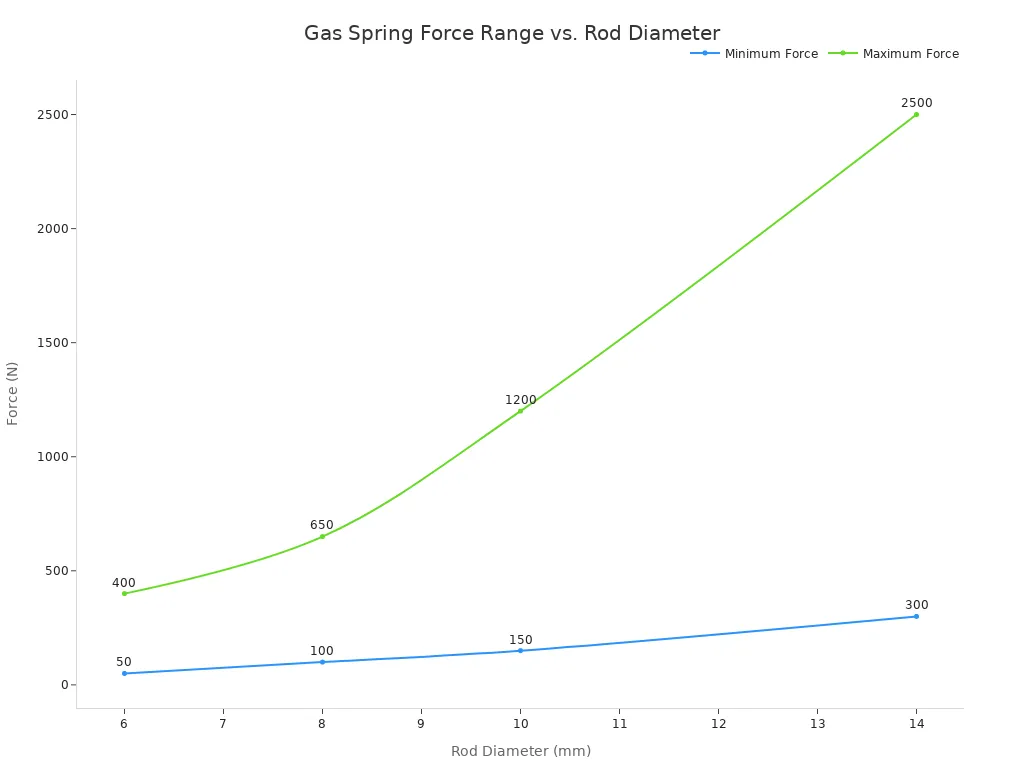
This pattern shows why the 6mm to 30mm range serves so many gas spring uses. A 6mm rod handles light loads up to 400 N. A 14mm rod manages heavy equipment covers needing up to 2500 N. The full range supports forces from about 10 N to 2400 N based on your setup.
Industrial gas springs from major manufacturers offer forces from 10 to 13,000 N, confirming the versatility of this technology across demanding environments.
Furniture, Medical, and Aerospace Applications
The gas springs you need change by industry. Furniture uses include adjustable desks and height-adjustable workstations. These use smaller rods in the 6mm to 10mm range for smooth, controlled lifting. Medical beds have stricter needs. You need stainless steel gas springs, often 304 or 316 grade, to handle harsh cleaning chemicals and moisture. Lockable gas springs let backrests hold positions at set angles. The stroke length must match the travel distance for safe bed section adjustments.
Aerospace uses demand the highest standards. Parts must meet AS 9100 quality management and RTCA DO-160G environmental testing. These certifications ensure reliability under extreme conditions. Marine settings also need corrosion-resistant rods for hatch covers and utility compartments.
The damping features of your gas spring control motion quality. Proper damping stops sudden jerks or slams during use. You want smooth, steady movement whether opening a medical cart drawer or lowering a heavy machine guard. The 0.2μm Ra surface finish on HZX rods supports consistent seal contact, which directly improves damping control through the whole stroke.
Every use shares one need: reliable, repeatable performance. The 6mm to 30mm rod range, plus proper material choice and surface treatment, delivers that reliability across all these different uses.
Wholesale Sourcing for Diverse Applications
Bulk Ordering, MOQs, and Lead Times
When you plan to buy in bulk, knowing the minimum order amounts helps you plan your budget. HZX offers flexible minimum order rules that work for different buying stages. For standard rod sizes, you can start with just 100 pieces. This low start lets you check quality before ordering more. If you need fully custom sizes, the minimum order is often negotiable, usually starting at 100 pieces for a first trial order. Factory-direct custom work for gas struts follows a slightly different path, with a set minimum of 200 pieces.
Your order size also changes the price per piece and how long it takes to get them. The table below shows typical minimum order levels you might see:
MOQ Category | Minimum Quantity |
|---|---|
Sample order | 1 kg |
Chrome-plated rod | 1 ton |
Bulk production | 20 tons or more |
Sample orders let you test rod quality in your own assembly line. Chrome-plated rod orders at one ton are good for medium-sized production runs. Bulk production over 20 tons gives the best price per piece for high-volume makers. HZX makes over 40 million pieces each year, so you can go from trial to full production without changing suppliers.
Ensuring Supplier Reliability and Customization Options
Reliable suppliers back their products with known certifications. When you check a piston rod maker, look for ISO9001:2015 certification as a basic quality standard. For car supply chains, IATF 16949 (old name TS16949) shows they meet tougher industry rules. Environmental certifications like ROHS and REACH confirm that materials meet limits on harmful substances. SGS test reports give independent proof of product claims. HZX has ISO9001 certification and provides SGS test reports, giving you written proof for every batch.
Custom options go beyond simple length changes. You can pick finishes that match your product design. Chrome plating gives a classic shiny look. Black chrome offers a darker, more modern style. Satin nickel and brushed finishes are good for high-end furniture uses. Powder coating lets you match colors to your exact brand needs.
Material upgrades matter for tough environments. Stainless steel grades 304 or 316 resist rust in marine or medical settings. Titanium offers very high strength for its weight, used in special applications. Zinc-nickel plating adds more rust protection for outdoor use.
Clear talks about specs stop costly mistakes in bulk orders. You should say rod diameter, length, material grade, surface finish, and tolerance class before making begins. This clarity makes sure every piece meets your exact needs. The benefits of precise specs include fewer rejects, steady assembly performance, and predictable damping behavior over the product's life. Smooth, controlled motion in your final gas spring assembly depends on getting these details right from the start.
HZX sells solid gas spring piston rods only in sizes from 6mm to 30mm. You get exact details for material, tolerance, and finish. These details make the rods last and work well in many different uses. If you choose SAE 1045 carbon steel or 304 stainless steel, each rod has h8 tolerance and a 0.2μm Ra surface finish.
Working with HZX gives you clear advantages. You can use over 40 million pieces of production each year. ISO9001 certification and SGS test reports prove the quality is the same every time. You can customize lengths and surface finishes to fit your needs. Smooth movement and steady damping rely on these exact parts. Good damping makes seals last longer and keeps gas spring behavior steady.
Get in touch with HZX now. Talk about your gas spring needs, ask for a price, or look into custom options for your next project.
FAQ
How do I determine the correct rod diameter for my gas spring?
Pick the rod diameter that gives the force you need. Larger rods go with bigger tubes and make higher forces. Standard pairs are 6/15 mm, 8/18 mm, and 10/22 mm. Think about your retract force needs. A bigger rod makes less space for pressure, so retract force goes down.
What is the difference between SAE 1045 carbon steel and 304 stainless steel rods?
SAE 1045 carbon steel works well for standard indoor uses when cost matters. After treatment it gets a hardness of HRC 20-30. Pick 304 stainless steel for wet or medical places where rust is a problem. Both metals can have the standard h8 tolerance and 0.2μm Ra surface finish.
Can I order custom lengths for my gas spring piston rods?
Yes. HZX makes custom lengths for each order. Standard lengths range from 100mm to 600mm. But you can ask for exact sizes that fit your assembly. The closed length of your gas spring comes from the tube when compressed plus the fittings on the rod ends. So measure carefully before ordering.
What surface treatments work best for different applications of gas springs?
Chrome plating gives good wear resistance for carbon steel rods. Black chrome gives a darker look. Satin nickel works well for expensive furniture. For outdoor or wet places, think about zinc-nickel plating or choose stainless steel. Let the place you use it guide your choice.
How does rod surface finish affect gas spring performance?
The 0.2μm Ra finish makes tiny pockets that keep oil films. These films lower friction and stop the seal from scraping. A smooth surface also helps steady damping through the whole stroke. This gives steady movement and longer seal life for your gas spring assembly.


