
 Product Search


High Hardness Gas Spring Piston Rod Manufacturers with 6mm–30mm Diameter Capabilities
 Sep 21, 2026|
 View:3
High hardness gas spring piston rod manufacturers with 6mm–30mm diameter capabilities make rods that decide gas spring durability, wear resistance, and cycle life. Engineers and procurement specialists must check hardness specs, diameter precision, material quality, tolerances, customization options, lead times, and pricing before picking a gas spring piston rod manufacturer. A wrong spec leads to early wear, scoring, or field failures. Buyers who compare suppliers on measurable criteria find reliable partners and avoid costly spec mismatches. The focus stays on practical evaluation methods. Checking hardness data and diameter accuracy lowers risk. It also protects long-term performance in demanding applications. Careful supplier selection pays off across the product lifecycle.
Key Takeaways
Ask for hardness test reports (usually HRC 40-45) to check wear resistance and prevent early rod failure.
Pick rods with diameter tolerance ISO f7/g6 and surface roughness Ra ≤ 0.2 μm for the best seal performance.
Ask for third-party inspection reports and material mill certificates to prove independent quality.
Pick manufacturers with proven experience, ISO certification, and customization options to lower long-term risk.
High Hardness Requirements for Gas Spring Piston Rods
Hardness Scales Explained
Hardness testing on gas spring piston rods usually uses two scales: Rockwell C (HRC) and Vickers (HV). The HRC scale pushes a diamond cone into the rod surface with a heavy load. The HV scale uses a diamond pyramid and figures out hardness from the dent's diagonal. Both methods give a number that shows how well the rod resists staying dented. Engineers check hardness at many spots along the rod. This makes sure the treatment is even. One low reading means a weak area. That weak area will wear out faster than the rest of the rod.
Why Hardness Drives Wear Resistance
High hardness directly controls how a piston rod works inside a gas spring. A hard surface resists scratches from dust, metal bits, and constant sliding contact. It also stops scoring, a bad type of wear that harms the rod and the seal. Longer cycle life depends on this resistance. A soft rod gets grooves and pits early. Those defects damage the seal and let gas pressure escape. Custom piston rods for shock absorbers can be induction-hardened to a high surface hardness and hard chrome plated with a 20–30 μm layer. This mix gives a very hard, low-friction surface for tough suspension systems.
The QPQ surface treatment makes the rod hard and smooth. This process gives the rod a surface hardness of HRC 40–45 and a roughness of Ra ≤ 0.2μm.
HZX rods use QPQ treatment to reach HRC 40–45. The same process keeps surface roughness at Ra ≤ 0.2μm. Salt spray performance meets industry corrosion resistance standards. These numbers give buyers a clear standard. A supplier who cannot offer hardness test data is a real risk. Buyers should always ask for the test report before placing an order.
Diameter Capabilities from 6mm to 30mm
Applications Across the Diameter Range
Gas spring rods are often 6mm to 14mm wide. The larger 6mm–30mm range fits small to medium jobs. Thin rods work well in small furniture and office chairs. Thicker rods carry heavier loads in cars and machines.
You will find these rods in car trunk and hood springs, dampers, furniture, hospital beds, office chairs, study desks, toolboxes, and bike suspension systems. Each use needs a certain diameter. A car hood spring needs a rod strong enough to hold the hood up. A bike suspension needs a lighter rod so it moves easily. Buyers must pick the right rod size for the weight and use of the final product.
Achieving Precision at Every Size
Makers get exact sizes using automatic lines, grinding, and careful checks. Automatic lines keep output steady at high volume. Grinding smooths the rod to the right size. Then inspection checks every key measurement.
Several systems help with this. Coordinate measuring machines check shaft diameter within ±0.01mm. In-process gauges keep diameter changes within ±0.01mm during grinding. Profilometers check surface features and measure Ra values between 0.2 and 0.8 micrometers. Machine vision systems spot surface flaws at inspection stations. Optical systems find tiny cracks, grinding burns, and stress marks. Hardness testers check heat treat condition and surface hardness. Laser markers with barcode or RFID tags track materials, processes, and inspections.
HZX offers a wide range of diameters and lengths to cover most gas spring piston rod needs. Buyers should make sure a supplier's inspection data meets the required tolerance before ordering.
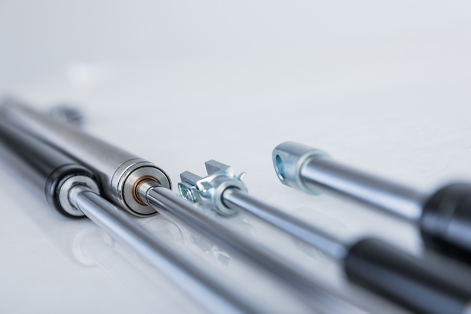
Key Criteria for Selecting a Gas Spring Piston Rod Manufacturer
Materials, Heat Treatment, and Surface Finish
The base steel grade is the starting point for how well a rod performs. C45 carbon steel works well for everyday gas spring jobs. Stainless steel grades give much better rust protection in harsh places. Each grade has different mechanical properties and costs. Buyers should match the steel grade to the place where it will be used and the load it must handle.
Heat treatment turns the steel surface into a layer that resists wear. Induction hardening makes a hard case on the rod surface while keeping the inside tough. This process works well for shock absorber rods that need high surface hardness. QPQ treatment is another option. This process gives rods a surface hardness of HRC 40–45 and very good rust resistance. Chrome plating adds a hard, low-friction layer on top of the base steel.
Chrome thickness affects both rust resistance and how long the rod lasts. For hydraulic piston rods made from C45 steel, a typical hard chrome plating thickness of 20–30 μm is normal. Severe-duty rods use 35–40 μm. Chrome hardness usually reaches 800–1,100 HV. This hardness gives excellent wear resistance against polyurethane and PTFE seals. The layer can chip if the steel underneath rusts, so proper base preparation matters.
Electroplating puts on a chromium layer (usually 20–50 microns), which adds hardness and rust resistance. For equipment that runs all the time, choose rods with a hardness rating of 900+ HV and a finely polished finish.
Tolerances, Surface Finish, and Certifications
Tight tolerances show which suppliers are reliable and which are just average. Diameter tolerance usually follows ISO f7 or g6 fit classes. Roundness should stay within half of the diameter tolerance. Straightness for rods up to 16mm should not go over 0.3 mm per 1000 mm. Larger rods should hold 0.2 mm per 1000 mm or better. Surface roughness targets Ra ≤ 0.2 μm for smooth seal operation.
Buyers should ask for specific documents before committing to a gas spring piston rod manufacturer. The table below shows what to ask for.
Report / Certificate | Verification Purpose | Relevant Parameter |
|---|---|---|
Third-Party Inspection Reports (SGS, BV, TUV) | Independent verification of product quality | Covers hardness and surface roughness tests |
Hardness Test Certificate | Confirms mechanical hardness | HRC 15–22 (normalized range) |
Surface Roughness Test | Confirms polished finish quality | Ra ≤ 0.2 μm |
Material Mill Test Certificate (EN 10204 3.1 / 3.2) | Confirms material compliance | Supports overall quality verification |
ISO 9001:2015 Quality Management Certification | Confirms process quality system | Supports consistency of testing |
These documents give buyers measurable proof of quality. A supplier who cannot provide hardness test reports and tolerance data is a real risk. Asking for samples along with test reports confirms both the product and the supplier's documentation practices.
Evaluating Manufacturer Expertise and Customization
Experience, Capacity, and Lead Times
How long a manufacturer has been in business affects how reliably they deliver. Top gas spring makers have over 23 years of experience making gas springs. Others have 12 years of production experience. More years usually means better processes and fewer defects. Before you commit, check how long a supplier has been making piston rods.
Production capacity shows which suppliers are reliable and which are small shops. The benchmarks below help you evaluate any gas spring piston rod manufacturer.
Metric | Benchmark |
|---|---|
Minimum factory size | 1,500+ m² |
Minimum engineers | 20+ |
On-time delivery rate | ≥95% |
Average response time | ≤4 hours |
Reorder rate | >25% |
High-volume facility size | >15,000 m² |
HZX meets these benchmarks with a sizable factory, a dedicated team, and substantial annual output. Lead times stay steady when a manufacturer works at this scale. Before signing contracts, buyers should ask for on-time delivery data.
Custom Diameters, Lengths, and End Configurations
Not every gas spring uses a standard rod size. Many uses need custom dimensions. Reliable manufacturers offer OEM and ODM services to meet these needs. They give samples before production runs. This lets buyers test fit and function early. Support for related gas spring accessories also matters. One supplier who delivers rods, fittings, and seals makes the supply chain simpler.
Hollow piston rods fill a special need in weight-sensitive designs. Bicycle suspension systems gain from less mass without losing strength. A hollow rod cuts weight while keeping the outer diameter needed for seal fit. The same machining precision applies to solid and hollow rods alike.
Buyers should make sure a manufacturer handles custom lengths and diameters across the required range. A supplier who offers both standard and custom solutions avoids costly redesigns later. Testing samples from the actual production process confirms tolerance holding across the whole run.
Sourcing, Cost, and Why Choose Hengzhixin
Comparing Quotes, MOQs, and Total Cost
Prices for gas spring piston rods are very different from one supplier to another. Buyers should look at more than just the unit price. The tolerance class changes the cost. A common rod with ±15% force tolerance costs less. A precision rod with ±5% tolerance costs more because it needs tighter control and batch matching. The table below shows how tolerance affects performance and price.
Factor | Commodity Tolerance (±15%) | Precision Tolerance (±5%) |
|---|---|---|
Labeled force | 200 N (45 lbf) | 200 N (45 lbf) |
Possible deviation | Up to 230 N vs 170 N (60 N imbalance) | At most ~20 N (4.5 lbf) difference |
Batch matching | Drawn from different batches | Matched from a single batch |
Effect on assembly | Twists panel, uneven wear, door misalignment | Lifts evenly |
Cost implication | Lower cost | Higher cost due to tighter control and batch matching |
Minimum order quantities also change the total cost. Some suppliers take trial amounts and give realistic delivery schedules. One supplier says that for standard size piston rods, there is no MOQ limit. They also support 1 piece of small batch custom prototype orders. They send a custom quote within 2 hours after getting a drawing. Another supplier notes that MOQ depends on rod diameter, specification and finish, and they keep a large stock of common sizes for faster delivery. Buyers should think about shipping, lead times, and reorder costs when comparing quotes. A low unit price with long lead times may cost more over the product lifecycle.
Why Choose Hengzhixin as Your Gas Spring Piston Rod Manufacturer
Changzhou Hengzhixin Machinery Co., Ltd. works under the HZX brand. The company holds relevant quality certifications and provides third-party test reports. It exports to international markets. These credentials give buyers independent proof of quality and process control.
HZX puts customers first. The company offers OEM and ODM services. Buyers can ask for samples and test reports before committing to production runs. HZX delivers both standard and custom solutions. Rods come in a wide range of diameters and lengths. The factory is sizable with a skilled team and high annual output. This capacity supports large orders without sacrificing quality.
A reliable gas spring piston rod manufacturer should provide hardness test reports, tolerance data, and clear pricing. HZX meets these requirements. The company's QPQ treatment gives rods a surface hardness of HRC 40–45 and a roughness of Ra ≤ 0.2μm. Salt spray performance meets industry corrosion resistance standards. These measurable figures help buyers verify quality before placing orders. HZX also supports related gas spring accessories, which simplifies the supply chain. Buyers who need standard components or custom designs can request a quote and samples to confirm fit and function.
Hardness checks, diameter accuracy from 6mm–30mm, material and process quality, tolerances, custom support, and supplier trust shape every buying choice. A gas spring piston rod manufacturer with proven hardness and diameter skills directly affects gas spring performance and how long it lasts. Weak hardness data or loose tolerances cause early wear and failures in the field. Buyers should ask for samples, hardness test reports, and tolerance data before committing to any supplier. These documents prove measurable quality and lower risk. Careful evaluation protects the product lifecycle and avoids costly spec mismatches. Reliable partners deliver steady rods that meet each application's demands.
FAQ
What hardness level does a gas spring piston rod typically need?
Makers aim for HRC 40–45 for normal gas spring rods with QPQ treatment. Shock absorber rods can be induction-hardened to achieve high surface hardness. Hardness decides wear resistance and cycle life. Low hardness leads to early scoring and seal damage.
Can manufacturers supply rods outside the 6mm to 30mm range?
Most gas spring uses take diameters between 6mm and 14mm. Makers like HZX have rods in a range of diameters and lengths. Custom sizes need OEM service. Buyers must check the range before ordering.
Which steel grade works best for a corrosive environment?
Stainless steel grades give excellent rust protection. C45 carbon steel works fine for standard indoor uses. Buyers must pick the steel grade based on the place of use and the load it must carry.
What documentation proves rod quality before purchase?
Buyers need to ask for a hardness test certificate, surface roughness report (Ra ≤ 0.2 μm), and material mill test certificate. Reports from SGS or a similar company prove independent quality checks. These papers stop specification mismatches.
Does HZX hold quality certifications for its piston rods?
Yes, HZX holds relevant quality certifications and provides third-party test reports. It exports to international markets. These papers give buyers independent proof of process control and steady quality.
Recommended Products

QPQ (Quench-Polish-Quench) Nitrided Piston Rod for Gas Spring

High Quality Hollow Hydraulic Rod For Gas Spring

QPQ hollow piston rod for Gas Spring support rods used in furniture Parts

Hard Chrome hydraulic rod for medical bed gas spring

Gas Spring Rod Accessories

φ10mm Chrome plated piston rod for Gas Spring

QPQ hollow piston rod for Gas Spring | 6mm Chrome Plated Bar

QPQ hollow steel shaft | rod for gas spring

High quality hard chrome plated piston rod for gas spring,damper

Hard Chrome Plated Piston Rod for Gas Spring


Recent News
1.Gas Spring Rods in Bicycles: Enhancing Performance and Comfort
2025-04-292.A Deep Dive into the Chrome Piston Rod for Gas Springs
2025-09-103.The 4 Main Parts of a Gas Spring
2025-11-194.Guide to Gas Spring Piston Rods: Design, Types, and Supplier Selection
2026-02-095.Professional Automotive Gas Spring Piston Rod Supplier: Infusing Reliability into Your Supply Chain
2026-02-286.Top 10 Gas Spring Accessories Suppliers in the World for 2026
2026-04-287.Bulk Order Solid Piston Rods for Furniture Gas Springs
2026-07-208.Custom Solid Piston Rods for Gas Springs – OEM Factory with ISO 9001 ; SGS Certification
2026-08-059.Precision Solid Gas Spring Piston Rod Factory for Diameter 6mm to 30mm
2026-08-3110.Wholesale Solid Gas Spring Piston Rods Strictly Within 6mm To 30mm Size
2026-09-09


