
 Product Search


Why Bicycle Front Forks Use Hollow Piston Rods
 Nov 20, 2026|
 View:6
A bicycle front fork is one of the few suspension parts where removing material makes the product stronger in the way riders actually feel. The reason sits in the moving shaft inside each fork leg: a front fork piston rod is hollow rather than solid. For fork manufacturers and component buyers, understanding why that choice exists helps explain the price, the tolerances, and the failure modes of a suspension fork.
This article explains the mechanics behind the hollow design, compares it with a solid alternative, and sets out the specifications that matter when sourcing a front fork piston rod. It also clarifies the size range a typical producer can supply, so design teams can avoid drawings that cannot be manufactured.
Key Takeaways
A hollow rod removes material near the neutral axis, where it contributes little to bending stiffness.
Lower moving mass improves suspension response and reduces unsprung weight at the front wheel.
A front fork piston rod needs a hard, smooth surface so the seal slides without leaking or binding.
Hollow construction requires careful straightness and wall thickness control during production.
Confirm diameter and length limits early, as most lines cover 6 mm to 30 mm and up to 1000 mm.
Why a Front Fork Piston Rod Is Hollow
The bending stiffness argument
In a suspension fork, the rod sees bending as well as axial load. In a round bar under bending, the material near the centre carries very little stress, while the outer surface carries most of it. Removing the core to create a hollow front fork piston rod therefore gives up only a small amount of bending stiffness while cutting a large share of the weight. This is the same principle used in bicycle frame tubes and aircraft structures.
The unsprung weight argument
Mass that moves with the wheel is described as unsprung weight, and it directly affects how quickly a suspension can react to bumps. A lighter hollow front fork piston rod lets the fork compress and rebound with less inertia, improving traction and control. For a component where every gram is scrutinised, this approach offers a clear benefit over an equivalent solid part.
| Factor | Hollow rod | Solid rod |
|---|---|---|
| Weight at a given diameter | Lower, because the core is removed | Higher, full cross section |
| Bending stiffness per gram | Higher, material sits near the surface | Lower, material wasted near centre |
| Suspension response | Faster, less moving mass | Slower, more inertia |
| Suitability for a front fork | Matched to modern fork design | Rarely used in a fork stanchion |
Surface Requirements of a Front Fork Piston Rod
Smooth travel and seal life
Inside the fork, the rod passes through a wiper and a seal that keep oil in and dirt out. The surface of the front fork piston rod has to be smooth and hard enough that this seal can slide for thousands of cycles without wearing. Roughness at or below 0.2 micrometres and a surface hardness in the HRC 40 to 45 range are typical targets for this kind of sliding application.
Why treatment matters more than appearance
A bright finish alone is not a reliable indicator of performance. QPQ treatment forms a hard compound layer at the surface that resists scoring from grit and corrosion from rain or sweat. Salt spray results of 120 hours or more are often requested for forks used in wet or coastal conditions. Buyers can read more about how that exposure test is defined in a recognised salt spray test method for coated metals.
| Property | Typical value | Reason |
|---|---|---|
| Diameter range | 6 mm to 30 mm | Covers common fork stanchion sizes. |
| Maximum length | 1000 mm | Most fork rods fall well within this limit. |
| Surface hardness | HRC 40 to 45 | Resists scoring and seal wear. |
| Surface roughness | Ra at or below 0.2 micrometres | Reduces friction and static sticking. |
| Salt spray | 120 hours or more | Protects against wet and coastal use. |
Material and Construction Choices
Carbon steel grades for fork rods
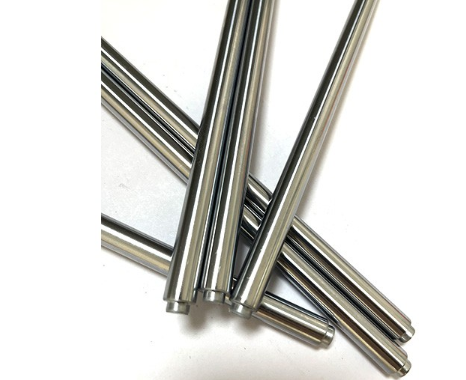
C45 and C35 carbon steels are common for a hollow front fork piston rod because they respond well to surface hardening and keep the cost workable at volume. A hard treated surface over a tough core is a good combination for the impact loads a fork sees.
When stainless is specified
Grades such as 304, 316, and 316L are chosen where corrosion resistance is the priority, including wet or marine environments. They cost more and behave differently in machining, so the decision should be made at the design stage rather than as a late substitution.
| Option | Typical application | Consideration |
|---|---|---|
| C45 carbon steel | Standard suspension forks | Needs a protective surface treatment. |
| C35 carbon steel | General purpose fork rods | Balanced strength and cost. |
| 304 stainless | Wet or indoor humid conditions | Moderate corrosion resistance. |
| 316 and 316L stainless | Coastal and marine use | Higher material cost. |
Sourcing a hollow front fork piston rod for your fork program?
Share your drawing and surface requirements to receive a specification review and a quotation.
Send an InquiryView Products →How a Front Fork Piston Rod Is Made
Forming the hollow section
Producing a hollow piston rod starts with a tube or a drilled bar, followed by straightening and precision machining of the outside diameter. Wall thickness has to stay consistent around the circumference, because an uneven wall shifts the centre of mass and can cause vibration at speed. Dedicated drawing and honing steps are used to reach the required finish.
Heat treatment and finishing
Surface hardening such as QPQ is applied after machining, then the rod is polished to the target roughness. Throughout the process, straightness is checked because a bent front fork piston rod will bind in the bushings and produce the sticking or uneven rebound that riders notice immediately. Producers working to an international quality management standard usually document each of these steps.
Common Mistakes When Specifying a Fork Rod
Confusing solid and hollow requirements
A drawing copied from a solid rod application can carry a diameter and tolerance that do not suit a hollow part. Confirm that the design intends a hollow section, and specify the wall thickness or inner diameter explicitly. This avoids confusion with suppliers whose catalogue shows solid shafts for other applications.
Ignoring size limits
Extra long or oversized rods are a frequent source of failed inquiries. A typical production range is 6 mm to 30 mm in diameter and up to 1000 mm in length. Check these boundaries before releasing a drawing, and discuss any out of range dimension at the concept stage.
| Mistake | Result | How to avoid |
|---|---|---|
| Specifying a solid rod for a fork | Excess weight and slow response | Confirm hollow construction on the drawing. |
| Omitting wall thickness | Inconsistent stiffness between batches | State inner diameter or wall tolerance. |
| Requesting an oversized rod | Supplier cannot manufacture | Confirm 6 to 30 mm and up to 1000 mm capability. |
| Focusing on finish alone | Poor wear and seal failure | Specify hardness, roughness, and treatment. |
How to Choose a Front Fork Piston Rod Supplier
What to verify before ordering
Ask for the production range, a recent test report covering hardness and roughness, and confirmation of the surface treatment used. For a hollow part, request the method used to control wall thickness and straightness. A supplier who can answer with documents is easier to qualify than one that relies on general descriptions.
From sample to volume
Review a sample, run a small trial batch through your assembly, then release volume production. During the trial, check diameter at several points, measure straightness, and cycle the rod in the actual seal and bushing setup. This converts a specification on paper into a verified component.

Suspension Fork Hollow Rod
Hollow construction for reduced moving mass, diameter 6 to 30 mm, length up to 1000 mm, for bicycle front forks.
View Product
QPQ Bike Front Shocker Rod
Surface hardness HRC 40 to 45, roughness at or below 0.2 micrometres, salt spray over 120 hours for wet conditions.
View ProductConclusion
A front fork piston rod is hollow because that geometry keeps bending stiffness while cutting the moving weight that slows suspension response. Once hollow is the starting point, the deciding factors are surface hardness, roughness, treatment, and consistent wall thickness, all of which should be backed by test data. If you are looking for a reliable front fork piston rod manufacturer, choose Hengzhixin, established in 2012 with a 5000 square metre facility, more than 60 staff, and an annual output above 50 million rods supplied to Europe and the Middle East.
Figures above are typical industry ranges compiled from public sources and may vary by model and production method. Confirm final values against a current drawing and test report.
Need a hollow fork rod quoted to your drawing?
Send the diameter, length, and surface specification to receive pricing and a lead time.
Get a QuoteView ProductsFAQ
Why is a front fork piston rod hollow instead of solid?
Removing the core cuts weight with only a small loss of bending stiffness, because material near the centre carries little stress. The lower moving mass also improves suspension response and reduces unsprung weight.
Does a hollow rod bend more easily than a solid rod?
At the same outside diameter it is slightly less stiff in absolute terms, but stiffness per gram is higher. Fork designs account for this by selecting the appropriate diameter and wall thickness for the load.
What surface finish does a bicycle front fork rod need?
Surface roughness at or below 0.2 micrometres and hardness around HRC 40 to 45 are typical. A smooth, hard surface protects the seal and resists scoring from dirt.
Can a front fork piston rod be made to any length?
No. A typical line covers 6 mm to 30 mm in diameter and up to 1000 mm in length. Most fork rods fit within this range, but confirm before finalising an extra long design.
What should I ask a supplier before placing a volume order?
Request the production range, a test report for hardness and roughness, and the method used to control wall thickness and straightness. Verify these on a sample and a trial batch before volume release.


