
 Product Search


What are the different types of piston rods?
 Apr 17, 2026|
 View:389
A Comprehensive Guide to the Different Types of Piston Rods
In the world of mechanical engineering and consumer goods manufacturing, the piston rod is a critical component that translates linear force into motion. Whether in a sleek bicycle suspension fork, a smooth-operating office chair gas spring, or a high-performance mountain bike shock absorber, the piston rod must withstand dynamic stress, friction, and environmental challenges to ensure reliability and performance.
Selecting the right type of piston rod is crucial for optimizing function, durability, and user experience. This guide explores the different types of piston rods based on their structure, material, and surface treatment, specifically tailored for applications in bicycle components, furniture hardware, and damping systems.
Key Application Areas:
Bicycle ForkFork DamperGas SpringBike Shock AbsorberOffice Furniture1. Classification by Structure: Solid vs. Hollow
The most fundamental distinction in piston rod design lies in its internal structure, which directly impacts weight, strength, and functionality.
Solid Piston Rods
Solid piston rods are manufactured from a single, solid piece of high-strength material. They are renowned for their robustness and reliability.
Characteristics: They offer superior compressive strength and resistance to bending. Their solid construction makes them exceptionally durable for applications involving direct impact and sustained loads.
Applications: They are the primary type used in gas springs for automotive trunks, office furniture, and industrial hardware. Their strength and stability make them ideal for applications where the rod is the primary load-bearing strut.
Advantages: High load-bearing capacity, excellent stability, and proven durability in cyclic loading scenarios common in lifting and damping mechanisms.
Hollow Piston Rods
Hollow piston rods feature a tubular design. This architecture is key for modern, lightweight, and multifunctional designs.
Characteristics: The primary advantage is significant weight reduction, which minimizes unsprung mass—a critical factor in vehicle dynamics. The hollow core is not merely for weight savings; it provides crucial design flexibility.
Unique Functionality: The internal cavity can serve as a conduit. In advanced bicycle fork and shock absorber designs, it allows for the internal routing of hydraulic fluid between chambers, enabling more compact and aerodynamically clean designs. It can also house sensors or wiring for electronic damping systems. The structure can also aid in heat dissipation.
Applications: Increasingly common in high-performance bicycle suspension forks (fork dampers), bike shock absorbers, and adjustable office chairs where minimizing weight and integrating internal fluid passages are essential for performance and design.
| Feature | Solid Piston Rods | Hollow Piston Rods |
|---|---|---|
| Weight | Heavier | Lightweight |
| Strength | Higher compressive strength | Good strength-to-weight ratio |
| Design Flexibility | Standard design | Internal routing capability |
| Primary Applications | Gas springs, standard dampers | Bicycle suspension, advanced dampers |
2. Classification by Material: Carbon Steel vs. Stainless Steel
The core material defines the rod's mechanical strength, fatigue resistance, and environmental resilience.
Carbon Steel Piston Rods (e.g., C45, CK45)
Carbon steel is the standard choice for its excellent balance of performance and cost.
C45 / CK45: A medium carbon steel offering good tensile strength, machinability, and wear resistance. It is the most common material for gas spring piston rods and general-purpose damper rods where high strength and good surface hardness (after treatment) are required.
Stainless Steel Piston Rods (e.g., 304, 316/316L)
Stainless steel is specified for applications where corrosion resistance is paramount, either for longevity or aesthetic reasons.
SS304: Provides good general corrosion resistance, suitable for indoor furniture applications or components where occasional moisture exposure is expected.
SS316 / 316L: Contains molybdenum, granting superior resistance to chlorides and harsh environments. This makes it ideal for high-end bicycle components (forks, shocks) exposed to road salt, mud, and water, as well as for medical or marine-grade applications.
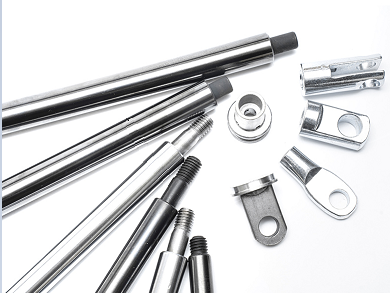
3. Classification by Surface Treatment: Chrome Plating vs. QPQ
The surface treatment is arguably as important as the base material. It protects against wear, reduces friction, and prevents corrosion.
Hard Chrome Plated Piston Rods
This is the traditional and widely used surface treatment for damping and spring components.
Benefits: Electroplated chromium creates an extremely hard, smooth surface that provides excellent abrasion resistance and a low friction coefficient. This is critical for maintaining the seal integrity in fork dampers and shock absorbers, ensuring consistent damping performance and long seal life.
Applications: The industry standard for decades in bicycle suspension, motorcycle forks, and automotive gas springs.
QPQ (Quench-Polish-Quench) Treated Rods
QPQ is an advanced salt-bath nitrocarburizing process that offers a high-performance, environmentally friendly alternative.
The Process: It diffuses nitrogen and carbon into the steel surface, creating a hard, corrosion-resistant compound layer without the use of hexavalent chromium.
Advantages:
Exceptional Corrosion Resistance: Can withstand 120+ hours in salt spray tests, far exceeding typical chrome plating, making it perfect for components exposed to harsh weather.
Environmental Safety: A cleaner process compliant with strict environmental regulations.
Anti-Galling Properties: Excellent for components with high surface pressure.
Applications: Gaining popularity in high-end bicycle components and outdoor equipment where durability in wet, muddy conditions is a key selling point, as well as in applications with strict environmental standards.
4. Specialized Piston Rods for Mobility and Furniture Applications
The specific demands of bicycles, motorcycles, and furniture have led to specialized piston rod requirements.
Piston Rods for Bicycle Suspension (Forks & Shock Absorbers)
These are precision components where performance is measured in millimeters and milliseconds.
Requirements: They demand an ultra-smooth surface finish (often Ra < 0.2 μm) to ensure buttery-smooth stanchion movement and minimal seal friction. They must be perfectly straight and concentric to prevent binding. Materials range from high-strength chrome-plated steel for durability to lightweight alloys for performance. Hollow designs are common in high-end models to save weight.
Piston Rods for Gas Springs (Lift Supports)
These rods enable the smooth operation of lifting mechanisms.
Requirements: They prioritize consistent diameter, high surface hardness, and good corrosion resistance to ensure a reliable seal over thousands of cycles. Solid rods are standard. The surface must be smooth to prevent seal damage and ensure effortless opening and closing of hatches, trunks, or office chair mechanisms.
Choosing the Right Piston Rod
Selecting the correct piston rod involves a careful balance of application needs:
Load & Function: For pure compression/extension in gas springs, a solid rod is typical. For dynamic damping in forks and shocks, a hollow rod may be preferred for weight and design integration.
Environment: For bicycle components exposed to the elements, Stainless Steel 316 or QPQ-treated rods offer the best longevity. For indoor furniture, chrome-plated carbon steel is often sufficient.
Performance: For high-end suspension, an ultra-smooth finish (Ra < 0.2μm) is non-negotiable for sensitive performance.
Regulations: Consider QPQ treatment for its environmental and performance benefits where heavy metals are a concern.
Technical Specifications at Hengzhixin Factory:
Diameter Range: 6mm to 30mm
Maximum Length: 1000mm
Surface Hardness: HRC 40-45
Surface Roughness: Ra < 0.2μm
Salt Spray Test: 120+ hours
From the robust solid rod in a desk chair's gas lift to the precision-honed hollow rod inside a mountain bike's rear shock, the piston rod is a tailored component critical to performance and reliability. Understanding the differences between solid and hollow construction, carbon and stainless steel, and chrome versus QPQ treatment is essential for designing and specifying the right part for the job.
Hengzhixin Factory specializes in manufacturing high-precision piston rods for these very applications. With capabilities covering diameters from 6mm to 30mm, lengths up to 1000mm, and expertise in both hard chrome plating and advanced QPQ treatments, we provide solutions that meet the stringent demands of the bicycle suspension, gas spring, and damping system industries. Our focus on superior surface finish and material integrity ensures our components deliver the durability, smoothness, and corrosion resistance required for top-tier performance.


